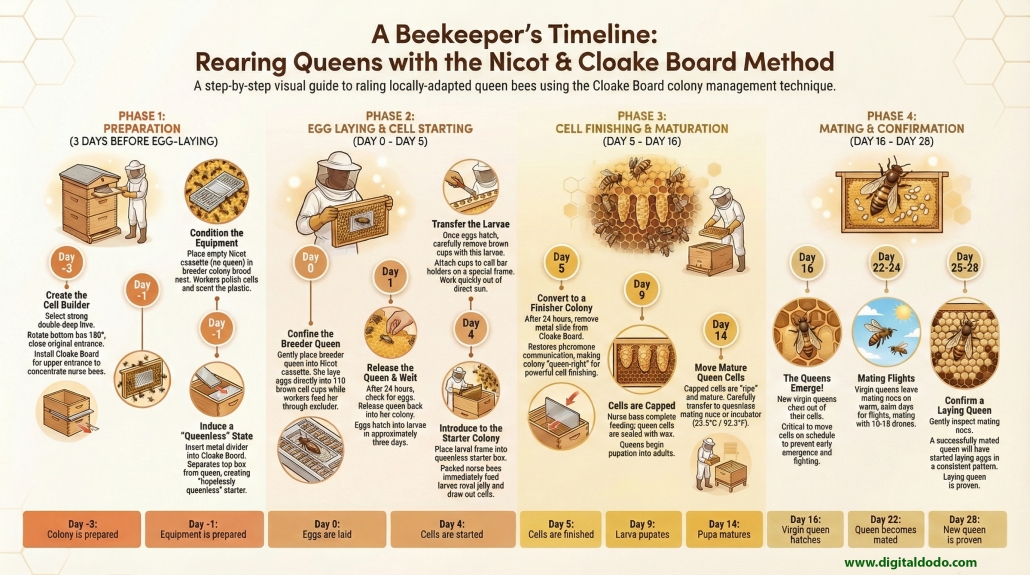
A Beginner’s Guide to Queen Rearing with the Nicot System and Cloake Board
Introduction: Simple “no graft” method of raising queens.
This is an intro describing how I raise queens – I have produced a detailed step by step guide and you can download a PDF version using the link:
Invalid download ID. Queen Rearing Guide Size: Invalid download ID.
While the idea of raising queens can seem intimidating, I hope this this explanation will demystify the process. The advantage of this method is that it can be done with a single colony acting as the breeder/starter and finisher. Apart from the initial manipulation there is no need to swap boxes/entrances around.
——————————————————————————–
- Understanding the Key Concepts
The core principles and tools behind the process are:
- 1.1. The Cell Builder: A “cell builder” is a special colony that is used to manage the initiation and care for queen cells in two states:
- The Starter (State of Emergency): When a colony is made “hopelessly queenless”, it enters a state of emergency. The worker bees’ instinct is to immediately raise new queens from any suitable young larvae they are given.
- The Finisher (State of Plenty): A strong, healthy colony with a queen (a “queen-right” colony) that is managed for constant growth creates a state of plenty. With a vast number of nurse bees and foragers, this colony is perfect for feeding and finishing the started queen cells until they are capped. Be aware that timing is critical; a cell builder in late Spring, when nurse bees’ hypopharyngeal glands are physiologically primed for peak royal jelly production, can raise significantly more high-quality cells than one set up in late Summer.
——————————————————————————–
- The Queen Rearing Toolkit
This checklist covers the essential equipment required for this process.
- A Strong, Double-Deep Hive: This very strong colony serves serves as the all-in-one cell builder.
- A Cloake Board: A specialised division board consisting of a slide, queen excluder and secondary entrance used to convert the cell builder from a starter to a finisher.

- A Nicot Queen Rearing Kit: This kit contains the core components for graft-free rearing. Key parts include the confinement box (cassette), removable brown cell cups, beige cup holders, and dark brown cell bar blocks. It should be attached to a standard brood frame ideally fitted with foundation which the bees will draw out when you first use it.
- A Cell Bar Frame: A specially modified frame with horizontal wooden bars to which you attach the cell bar blocks, spaced about 30mm apart, and where the developing queen cells will be attached.

- Receiving Colonies or Nucs: These are colonies or nucs where your newly emerged virgin queens will hatch, take their mating flights, and begin to lay eggs.
- Feeder and Feed: A top feeder and a steady supply of 1:1 sugar-water solution are critical for stimulating both the breeder queen and the cell builder colony.
——————————————————————————–
- The Queen Rearing Calendar: A Step-by-Step Walkthrough
This timeline breaks the entire process down into manageable phases and daily tasks. The “Day” count is based on when the queen lays the egg (Day 0). Following this calendar precisely is key to success.
- Phase 1: Preparation (The Week Before Transfer)
- Day -4: Prepare the Breeder Hive.
- Action: Select your best colony, the one headed by your “breeder queen.” Place the frame containing the Nicot cassette (without the cover or the queen) into the centre of her brood nest.
- Purpose: This is a “conditioning” step. The worker bees will clean and polish the plastic cell cups and coat the entire box with the hive’s unique scent. This is critical for ensuring the queen accepts the box and lays eggs in it.
- Day -3: Set Up the Cell Builder Colony.
- Action: Select a strong, double-deep hive to serve as your cell builder.
- Rotate the entire hive 180 degrees, so the main entrance now faces the back.
- Find the queen and confirm she is in the bottom box.
- Place the Cloake Board (with its metal slide removed for now).
- Place the second deep box on top of the Cloake Board. Ensure this top box contains frames of pollen, honey, and unsealed brood to attract a large population of nurse bees upwards.
- Close the original bottom entrance, which is now at the rear of the hive, and open the new entrance on the Cloake Board at the front.
- Purpose: This configuration forces all returning field bees to use the new top entrance, creating an incredibly crowded and powerful top box packed with nurse bees. Begin feeding the entire hive with 1:1 sugar syrup.
- Action: Select a strong, double-deep hive to serve as your cell builder.
- Day -4: Prepare the Breeder Hive.
- Phase 2: Cell Initiation (The Critical First Days)
- Day 0: Creating the Starter and Confining the Queen.
At the Cell Builder:Insert the metal slide into the Cloake Board. Open the rear entrance to the bottom box so the foraging bees with the queen can still fly. Purpose: This action completely separates the top box from the queen below, creating a “hopelessly queenless” starter colony, primed to raise new queens.
-
-
- At the Breeder Hive (Bottom box): Find your breeder queen and gently confine her inside the Nicot box on her frame. Purpose: With the excluder front trapping her, the queen will now lay her eggs directly into the conditioned brown cell cups over the next 24 hours while worker bees tend to her.
-
-
- Day 1: Release the Queen.
- Action: Check the Nicot box for eggs. If a sufficient number of cups have been laid in, you can remove the excluder cover and release the breeder queen back into her colony. The frame with the Nicot box and freshly laid eggs remains in the breeder hive to be cared for by the workers.
- Day 3-4: The “Graft” – Transferring Larvae.
- Action:
- Three days after the eggs are laid, they will hatch. The ideal age for transfer is within 12-24 hours of hatching, when they are tiny larvae, gently curved but not yet forming a ‘C’ shape.
- Perform the physical transfer in a shaded wind free area:
- Remove the back cover of the Nicot box.
- Gently push the brown cups containing larvae out from the back.
- Push each brown cup into a beige cup holder.
- Attach these completed assemblies onto the dark brown cell bar blocks on your cell bar frame.
- Go to the cell builder hive (Top box). Remove a central frame from the top (starter) box and place the completed cell bar frame in its place. Ensure it is surrounded by frames of pollen and honey.
- Action:
- Day 1: Release the Queen.
- Phase 3: Cell Finishing and Maturation
- Day 5: Convert to a Finisher.
- Action:
- Gently inspect the cells. You should see that the bees have accepted them by starting to draw out the wax and provisioning them with abundant royal jelly.
- Remove the metal slide from the Cloake Board. Close the rear entrance to the bottom box again.
- Check that there are no other queen cells on any of the frames in the top box – remove any that you find.
- Purpose: Removing the slide converts the top box of the hive into a “queen-right finisher.” The queen’s pheromones can now circulate throughout the hive, stabilising the colony, but the queen excluder still prevents her from reaching and destroying the developing queen cells. Forcing all the foragers back through the top entrance maximises the population caring for the cells.
- Day 9: Cells are Capped.
- Action: Check the cells. About five days after your transfer, the bees will have sealed them with wax. From this point on, they no longer require active feeding.
- You can, optionally, rearrange the floor under the bottom box to revert to having the entrance back to its original position at the front of the hive. Keep the Cloake board in place or replace with a standard queen excluder between the two brood boxes.
-
- Day 14: Ripe Cells and Preparing Mating Nucs/Colonies.
- Action:
- The queen cells are now “ripe” and can be safely moved to their final destination before hatching.
- Gently brush the bees off the cell bar frame and carefully remove the ripe queen cells (cup assembly and all).
- Prepare your receiving colonies or nucs 24 hours beforehand by creating queenless colonies with frames containing some brood, honey, and plenty of nurse bees.
- Place one ripe queen cell into each mating nuc or hive. It is best to install the cell between frames of sealed and emerging brood.
- Action:
- Day 14: Ripe Cells and Preparing Mating Nucs/Colonies.
- Phase 4: Mating and Verification
- Day 15-16: Emergence. The virgin queens will hatch from their cells inside the mating nucs/colonies.
- Day 22-24: Mating Flights. Weather permitting, the virgin queens will leave their hives/nucs for their crucial mating flights. It is extremely important that you do not disturb the mating hives during this period.
- Day 28+: Check for Success. Wait at least two weeks from the expected hatch date before your first inspection. Open the mating colony and look carefully for eggs = laying queen
——————————————————————————–- Key Tips for Success
Over the years, I’ve learned that success in queen rearing often comes down to a few core principles. Keep these tips front of mind:
- Strong Double Brood Colony: Make sure the colony you are going to use is a very strong one with at least 10 frames of brood. Strengthen by adding frames of capped brood from other colonies 2-3 weeks before Day 0.
- Start with More Than You Need: Queen rearing is a numbers game. If you need 10 mated queens, plan to start 20 or 30 cells.
- Feed, Feed, Feed: A state of abundance is critical. Both the breeder colony and the cell builder must be fed continuously with 1:1 sugar syrup and have access to ample pollen, especially if there is no natural nectar flow. This stimulates the queen to lay and ensures nurse bees can produce high-quality royal jelly.
- The Importance of Nurse Bees: The success of your cell builder is directly proportional to its population of young nurse bees (5-11 days old). These are the bees whose hypopharyngeal glands produce the royal jelly required to raise queens. A strong starter is packed with them.
- Beware of Rogue Queen Cells: When you create the starter, you must thoroughly inspect all frames in the top box for any naturally drawn “rogue” queen cells and destroy them.
-
- Action:
- Day 5: Convert to a Finisher.
-
- Day 14: Ripe Cells and Preparing Mating Nucs/Colonies.
- Action:
- The queen cells are now “ripe” and can be safely moved to their final destination before hatching.
- Gently brush the bees off the cell bar frame and carefully remove the ripe queen cells (cup assembly and all).
- Prepare your receiving colonies or nucs a few hours beforehand by creating queenless colonies with frames containing some brood, honey, and plenty of nurse bees.
- Place one ripe queen cell into each mating nuc or hive. It is best to install the cell between frames of sealed and emerging brood.
- Action:
- Day 14: Ripe Cells and Preparing Mating Nucs/Colonies.
- Phase 4: Mating and Verification
- Day 15-16: Emergence. The virgin queens will hatch from their cells inside the mating nucs/colonies.
- Day 22-24: Mating Flights. Weather permitting, the virgin queens will leave their hives/nucs for their crucial mating flights. It is extremely important that you do not disturb the mating hives during this period.
- Day 28+: Check for Success. Wait at least two weeks from the expected hatch date before your first inspection. Open the mating colony and look carefully for eggs. A solid pattern of one egg per cell is the sign of a successfully mated and laying queen.
Successfully creating ripe cells is a major accomplishment, but ensuring they become productive queens requires careful management of their first homes.
——————————————————————————–
- Key Tips for Success
Over the years, I’ve learned that success in queen rearing often comes down to a few core principles. Ignore them at your peril. Keep these tips front of mind:
- Strong Double Brood Colony: Make sure the colony you are going to use is a very strong one with at least 10 frames of brood. Strengthen by adding frames of capped brood from other colonies 2-3 weeks before Day 0.
- Start with More Than You Need: Queen rearing is a numbers game. If you need 10 mated queens, plan to start 20 or 30 cells. Not all cells will be accepted, and not all virgin queens will mate successfully.
- Feed, Feed, Feed: A state of abundance is critical. Both the breeder colony and the cell builder must be fed continuously with 1:1 sugar syrup and have access to ample pollen, especially if there is no natural nectar flow. This stimulates the queen to lay and ensures nurse bees can produce high-quality royal jelly.
- The Importance of Nurse Bees: The success of your cell builder is directly proportional to its population of young nurse bees (5-11 days old). These are the bees whose hypopharyngeal glands produce the royal jelly required to raise queens. A strong starter is packed with them.
- Beware of Rogue Queen Cells: When you create the starter, you must thoroughly inspect all frames in the top box for any naturally drawn “rogue” queen cells and destroy them. If you miss even one, an emerged virgin queen will hatch and kill all the queens in your cell bars.
- Handle with Care: Young larvae are incredibly fragile. Capped cells are also vulnerable, especially between days 10-12 of the total cycle when the queen is pupating. Never shake a frame with developing cells and always handle it gently.
——————————————————————————–
- Conclusion: Your Journey as a Queen Rearer
By mastering this process, you are taking a significant step toward becoming a more self-sufficient and skilled beekeeper. The ability to produce your own high-quality, locally adapted queens is the foundation of a sustainable and resilient apiary. It allows you to select for the traits you value most—gentleness, productivity, and disease resistance—and gives you ultimate control over the future of your hives. This journey is one of the most rewarding aspects of beekeeping, and with care and practice, it is well within your reach.
A Beginner’s Guide to Queen Rearing with the Nicot System and Cloake Board
Introduction: Simple “no graft” method of raising queens.
This is an intro describing how I raise queens – I have produced a detailed step by step guide and you can download a PDF version using the link:
Invalid download ID. Queen Rearing Guide Size: Invalid download ID.
While the idea of raising queens can seem intimidating, I hope this this explanation will demystify the process. The advantage of this method is that it can be done with a single colony acting as the breeder/starter and finisher. Apart from the initial manipulation there is no need to swap boxes/entrances around.
——————————————————————————–
- Understanding the Key Concepts
The core principles and tools behind the process are:
- 1.1. The Cell Builder: A “cell builder” is a special colony that is used to manage the initiation and care for queen cells in two states:
- The Starter (State of Emergency): When a colony is made “hopelessly queenless”, it enters a state of emergency. The worker bees’ instinct is to immediately raise new queens from any suitable young larvae they are given.
- The Finisher (State of Plenty): A strong, healthy colony with a queen (a “queen-right” colony) that is managed for constant growth creates a state of plenty. With a vast number of nurse bees and foragers, this colony is perfect for feeding and finishing the started queen cells until they are capped. Be aware that timing is critical; a cell builder in late Spring, when nurse bees’ hypopharyngeal glands are physiologically primed for peak royal jelly production, can raise significantly more high-quality cells than one set up in late Summer.
——————————————————————————–
- The Queen Rearing Toolkit
This checklist covers the essential equipment required for this process.
- A Strong, Double-Deep Hive: This very strong colony serves serves as the all-in-one cell builder.
- A Cloake Board: A specialised division board consisting of a slide, queen excluder and secondary entrance used to convert the cell builder from a starter to a finisher.
- A Nicot Queen Rearing Kit: This kit contains the core components for graft-free rearing. Key parts include the confinement box (cassette), removable brown cell cups, beige cup holders, and dark brown cell bar blocks. It should be attached to a standard brood frame ideally fitted with foundation which the bees will draw out when you first use it.
- A Cell Bar Frame: A specially modified frame with horizontal wooden bars to which you attach the cell bar blocks, spaced about 30mm apart, and where the developing queen cells will be attached.
- Receiving Colonies or Nucs: These are colonies or nucs where your newly emerged virgin queens will hatch, take their mating flights, and begin to lay eggs.
- Feeder and Feed: A top feeder and a steady supply of 1:1 sugar-water solution are critical for stimulating both the breeder queen and the cell builder colony.
——————————————————————————–
- The Queen Rearing Calendar: A Step-by-Step Walkthrough
This timeline breaks the entire process down into manageable phases and daily tasks. The “Day” count is based on when the queen lays the egg (Day 0). Following this calendar precisely is key to success.
- Phase 1: Preparation (The Week Before Transfer)
- Day -4: Prepare the Breeder Hive.
- Action: Select your best colony, the one headed by your “breeder queen.” Place the frame containing the Nicot cassette (without the cover or the queen) into the centre of her brood nest.
- Purpose: This is a “conditioning” step. The worker bees will clean and polish the plastic cell cups and coat the entire box with the hive’s unique scent. This is critical for ensuring the queen accepts the box and lays eggs in it.
- Day -3: Set Up the Cell Builder Colony.
- Action: Select a strong, double-deep hive to serve as your cell builder.
- Rotate the entire hive 180 degrees, so the main entrance now faces the back.
- Find the queen and confirm she is in the bottom box.
- Place the Cloake Board (with its metal slide removed for now).
- Place the second deep box on top of the Cloake Board. Ensure this top box contains frames of pollen, honey, and unsealed brood to attract a large population of nurse bees upwards.
- Close the original bottom entrance, which is now at the rear of the hive, and open the new entrance on the Cloake Board at the front.
- Purpose: This configuration forces all returning field bees to use the new top entrance, creating an incredibly crowded and powerful top box packed with nurse bees. Begin feeding the entire hive with 1:1 sugar syrup.
- Action: Select a strong, double-deep hive to serve as your cell builder.
- Day -4: Prepare the Breeder Hive.
- Phase 2: Cell Initiation (The Critical First Days)
- Day 0: Creating the Starter and Confining the Queen.
- At the Cell Builder:Insert the metal slide into the Cloake Board. Open the rear entrance to the bottom box so the foraging bees with the queen can still fly. Purpose: This action completely separates the top box from the queen below, creating a “hopelessly queenless” starter colony, primed to raise new queens.
-
-
- At the Breeder Hive (Bottom box): Find your breeder queen and gently confine her inside the Nicot box on her frame. Purpose: With the excluder front trapping her, the queen will now lay her eggs directly into the conditioned brown cell cups over the next 24 hours while worker bees tend to her.
-
-
- Day 1: Release the Queen.
- Action: Check the Nicot box for eggs. If a sufficient number of cups have been laid in, you can remove the excluder cover and release the breeder queen back into her colony. The frame with the Nicot box and freshly laid eggs remains in the breeder hive to be cared for by the workers.
- Day 3-4: The “Graft” – Transferring Larvae.
- Action:
- Three days after the eggs are laid, they will hatch. The ideal age for transfer is within 12-24 hours of hatching, when they are tiny larvae, gently curved but not yet forming a ‘C’ shape.
- Perform the physical transfer in a shaded wind free area:
- Remove the back cover of the Nicot box.
- Gently push the brown cups containing larvae out from the back.
- Push each brown cup into a beige cup holder.
- Attach these completed assemblies onto the dark brown cell bar blocks on your cell bar frame.
- Go to the cell builder hive (Top box). Remove a central frame from the top (starter) box and place the completed cell bar frame in its place. Ensure it is surrounded by frames of pollen and honey.
- Action:
- Day 1: Release the Queen.
- Phase 3: Cell Finishing and Maturation
- Day 5: Convert to a Finisher.
- Action:
- Gently inspect the cells. You should see that the bees have accepted them by starting to draw out the wax and provisioning them with abundant royal jelly.
- Remove the metal slide from the Cloake Board. Close the rear entrance to the bottom box again.
- Check that there are no other queen cells on any of the frames in the top box – remove any that you find.
- Purpose: Removing the slide converts the top box of the hive into a “queen-right finisher.” The queen’s pheromones can now circulate throughout the hive, stabilising the colony, but the queen excluder still prevents her from reaching and destroying the developing queen cells. Forcing all the foragers back through the top entrance maximises the population caring for the cells.
- Day 9: Cells are Capped.
- Action: Check the cells. About five days after your transfer, the bees will have sealed them with wax. From this point on, they no longer require active feeding.
- You can, optionally, rearrange the floor under the bottom box to revert to having the entrance back to its original position at the front of the hive. Keep the Cloake board in place or replace with a standard queen excluder between the two brood boxes.
-
- Day 14: Ripe Cells and Preparing Mating Nucs/Colonies.
- Action:
- The queen cells are now “ripe” and can be safely moved to their final destination before hatching.
- Gently brush the bees off the cell bar frame and carefully remove the ripe queen cells (cup assembly and all).
- Prepare your receiving colonies or nucs 24 hours beforehand by creating queenless colonies with frames containing some brood, honey, and plenty of nurse bees.
- Place one ripe queen cell into each mating nuc or hive. It is best to install the cell between frames of sealed and emerging brood.
- Action:
- Day 14: Ripe Cells and Preparing Mating Nucs/Colonies.
- Phase 4: Mating and Verification
- Day 15-16: Emergence. The virgin queens will hatch from their cells inside the mating nucs/colonies.
- Day 22-24: Mating Flights. Weather permitting, the virgin queens will leave their hives/nucs for their crucial mating flights. It is extremely important that you do not disturb the mating hives during this period.
- Day 28+: Check for Success. Wait at least two weeks from the expected hatch date before your first inspection. Open the mating colony and look carefully for eggs = laying queen
——————————————————————————–- Key Tips for Success
Over the years, I’ve learned that success in queen rearing often comes down to a few core principles. Keep these tips front of mind:
- Strong Double Brood Colony: Make sure the colony you are going to use is a very strong one with at least 10 frames of brood. Strengthen by adding frames of capped brood from other colonies 2-3 weeks before Day 0.
- Start with More Than You Need: Queen rearing is a numbers game. If you need 10 mated queens, plan to start 20 or 30 cells.
- Feed, Feed, Feed: A state of abundance is critical. Both the breeder colony and the cell builder must be fed continuously with 1:1 sugar syrup and have access to ample pollen, especially if there is no natural nectar flow. This stimulates the queen to lay and ensures nurse bees can produce high-quality royal jelly.
- The Importance of Nurse Bees: The success of your cell builder is directly proportional to its population of young nurse bees (5-11 days old). These are the bees whose hypopharyngeal glands produce the royal jelly required to raise queens. A strong starter is packed with them.
- Beware of Rogue Queen Cells: When you create the starter, you must thoroughly inspect all frames in the top box for any naturally drawn “rogue” queen cells and destroy them.
-
- Action:
- Day 5: Convert to a Finisher.
-
- Day 14: Ripe Cells and Preparing Mating Nucs/Colonies.
- Action:
- The queen cells are now “ripe” and can be safely moved to their final destination before hatching.
- Gently brush the bees off the cell bar frame and carefully remove the ripe queen cells (cup assembly and all).
- Prepare your receiving colonies or nucs a few hours beforehand by creating queenless colonies with frames containing some brood, honey, and plenty of nurse bees.
- Place one ripe queen cell into each mating nuc or hive. It is best to install the cell between frames of sealed and emerging brood.
- Action:
- Day 14: Ripe Cells and Preparing Mating Nucs/Colonies.
- Phase 4: Mating and Verification
- Day 15-16: Emergence. The virgin queens will hatch from their cells inside the mating nucs/colonies.
- Day 22-24: Mating Flights. Weather permitting, the virgin queens will leave their hives/nucs for their crucial mating flights. It is extremely important that you do not disturb the mating hives during this period.
- Day 28+: Check for Success. Wait at least two weeks from the expected hatch date before your first inspection. Open the mating colony and look carefully for eggs. A solid pattern of one egg per cell is the sign of a successfully mated and laying queen.
Successfully creating ripe cells is a major accomplishment, but ensuring they become productive queens requires careful management of their first homes.
——————————————————————————–
- Key Tips for Success
Over the years, I’ve learned that success in queen rearing often comes down to a few core principles. Ignore them at your peril. Keep these tips front of mind:
- Strong Double Brood Colony: Make sure the colony you are going to use is a very strong one with at least 10 frames of brood. Strengthen by adding frames of capped brood from other colonies 2-3 weeks before Day 0.
- Start with More Than You Need: Queen rearing is a numbers game. If you need 10 mated queens, plan to start 20 or 30 cells. Not all cells will be accepted, and not all virgin queens will mate successfully.
- Feed, Feed, Feed: A state of abundance is critical. Both the breeder colony and the cell builder must be fed continuously with 1:1 sugar syrup and have access to ample pollen, especially if there is no natural nectar flow. This stimulates the queen to lay and ensures nurse bees can produce high-quality royal jelly.
- The Importance of Nurse Bees: The success of your cell builder is directly proportional to its population of young nurse bees (5-11 days old). These are the bees whose hypopharyngeal glands produce the royal jelly required to raise queens. A strong starter is packed with them.
- Beware of Rogue Queen Cells: When you create the starter, you must thoroughly inspect all frames in the top box for any naturally drawn “rogue” queen cells and destroy them. If you miss even one, an emerged virgin queen will hatch and kill all the queens in your cell bars.
- Handle with Care: Young larvae are incredibly fragile. Capped cells are also vulnerable, especially between days 10-12 of the total cycle when the queen is pupating. Never shake a frame with developing cells and always handle it gently.
——————————————————————————–
- Conclusion: Your Journey as a Queen Rearer
By mastering this process, you are taking a significant step toward becoming a more self-sufficient and skilled beekeeper. The ability to produce your own high-quality, locally adapted queens is the foundation of a sustainable and resilient apiary. It allows you to select for the traits you value most—gentleness, productivity, and disease resistance—and gives you ultimate control over the future of your hives. This journey is one of the most rewarding aspects of beekeeping, and with care and practice, it is well within your reach.

