
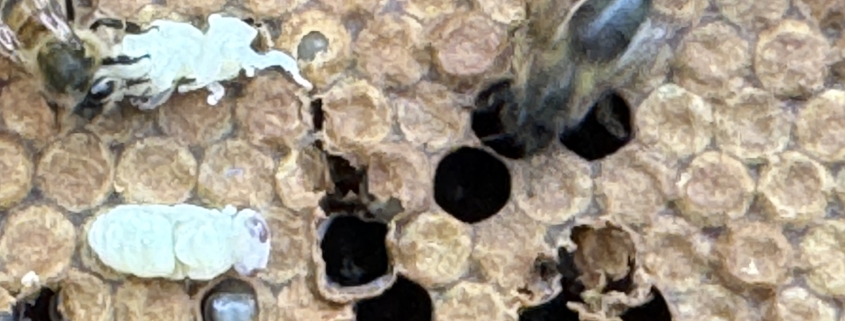
Varroa Mite Management with a Focus on Drone Brood Removal
An effective Integrated Pest Management (IPM) approach requires a multi-faceted strategy combining cultural, mechanical, and chemical controls to maintain mite populations below economic thresholds.
This article focuses on using Drone brood removal as a mechanical control method to manage Varroa mites in a colony. This non-chemical technique leverages the Varroa mite’s strong biological preference for reproducing in drone brood.
A 2005 study concluded that drone brood removal did not adversely affect colony health, worker populations, or honey production, positioning it as a valuable component in a comprehensive IPM program.
1: Why Mites Prefer Drone Brood
Varroa destructor exhibits a significant preference for drone brood over worker brood, with drone cells being 6 to 11 times more likely to be infested. This preference is driven by several biological factors:
- Longer Development Cycle: Drones have a longer post-capping period (15 days) compared to workers (11-12 days). This extra time allows a single foundress mite to produce more offspring.
- Higher Reproductive Success: On average, a foundress mite in a worker cell produces 1.3-1.4 surviving offspring, while a mite in a drone cell produces 2.2-2.6.
- Increased Attractiveness: The pre-capping larval stage, when mites enter the cell, is longer for drones (40-50 hours) than for workers (15-30 hours). Drone larvae also produce more of the pheromones (kairomones) that attract mites.
- Vector Opportunity: Drone brood is visited 2-3 times more frequently by nurse bees, which can carry mites and provide a route for them to enter the cell.
2. Efficacy and Quantitative Impact
Drone brood removal has the following results:
- Mite Population Reduction: The method can reduce mite levels by a range of 50-90% and therefore it can slow mite population growth by about 50%.
3. Practical Implementation
Do this when there is an impulse for the colony to produce drones – April to July. Use one of the two methods described below:
A) Drone Uncapping – The method involves getting the the colony to draw drone comb by giving them a shallow frame in a standard deep brood box. The bees will build drone comb in the empty space below the bottom bar, which can be easily cut away.
B) Drone Frame Removal – Give the colony a frame with drone foundation that can be removed when it is capped.
Step-by-Step Processes:
Uncapping: After the drone comb is drawn it will be laid up by the queen and once it is capped it can be removed. If you plan to uncap the pupae to count the mites then my preference is to do this 7 days after it is capped. Then the pupae will be at a stage where they can by pulled out with an uncapping fork rather than disintegrating. Whatever you do aim to complete the uncapping/removal before the drones hatch out on Day 24.The shallow frame can be put back and the bees will repeat the drone rearing cycle every 3-4 weeks. This also has the effect of concentrating the rearing of drones to one main area rather than spread throughout the colony.
Frame removal: If you have put a frame of drone foundation in the again remove the frame before Day 24. It can be placed in a freezer for 24-48 hours to kill both the drone brood and the mites within. After freezing and thawing, the dead brood is removed and the mites can be counted using an uncapping fork. You can clean out the frame with a hose and it can then be returned to the hive for reuse. Again the drone rearing cycle will be repeated but as bees don’t need to draw out the comb then it will be around every 3 weeks that you need to remove the frame.
4. My approach To Integrated Annual Management Plan:
- All Year: Use an Open Mesh Floor to allow mites that fall off bees to be ejected from the hive. Estimated to help reduce varroa mite numbers by 10%-15%.
- Use Drone brood removal between April – July on a 3-4 weekly cycle.
- If doing a split or hiving a swarm introduce a frame of unsealed brood after 3 days to attract the phoretic/dispersal mites the bees are carrying and once capped remove it and dispose of it. This way you should have a virtually mite free colony without having to resort to chemical treatments.
- Replace brood combs every 2-3 years either by selective replacement of 4 frames every year or a full replacement by performing either a Shook Swarm or Bailey Comb Change.